We may earn a commission when you buy through our links. Learn more
Choose a telescope from our catalog (its published aperture, focal length and largest included eyepiece fill in) or type your own. Every result is arithmetic on published figures; each formula and its source is listed under the tool.
Every formula, and where it comes from
Two worked examples
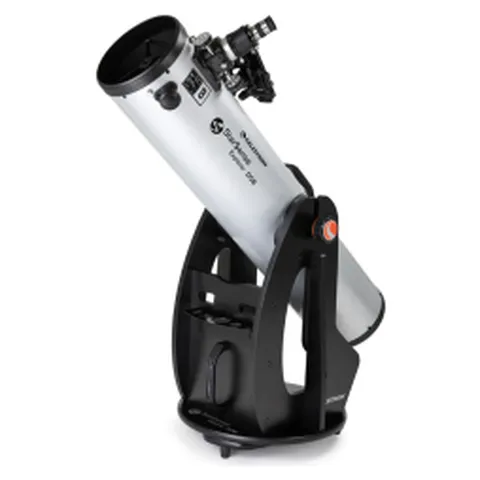
8-inch Dobsonian, 1200 mm, with its 25 mm eyepiece (the default): 1200 / 25 = 48x. Exit pupil 203 / 48 = 4.2 mm. True field 50 / 48 = 1.04°, about two full Moons. Jupiter: 46.9" x 48 = 37.5 arcmin, a bit more than the naked-eye Moon. Dawes: 116 / 203 = 0.57" (Celestron publishes 0.57" for its 8-inch SCT).
Same telescope, 10 mm eyepiece and 2x Barlow: 1200 x 2 / 10 = 240x, under the 480x Celestron publishes for its StarSense Explorer 8". Exit pupil 0.8 mm; true field 0.21°. Jupiter: 187.6 arcmin, about six naked-eye Moons wide.
Next: does it fit your car and your back? Will it fit? Or compare every model: telescope comparison.
Frequently asked questions
How much magnification do I need to see Saturn's rings?
The calculator shows how big Saturn's globe looks at any power: at 50x, its 18.8 arcsecond globe (NASA, average opposition) appears about 16 arcminutes wide, half the naked-eye Moon. Whether the rings show cleanly also depends on the air and the optics, which no formula captures.
Why is there a highest useful magnification?
Because the image dims and softens past it. Celestron's rule is 50 to 60 times the aperture in inches under ideal conditions; the brand's own figure for the model is shown when it publishes one.
What is exit pupil and why does my age matter?
The exit pupil is the beam of light leaving the eyepiece: eyepiece focal length divided by the focal ratio. If it is wider than your eye's pupil, light is lost. Wikipedia's table of night-time pupil sizes goes from 7.3 mm at 20 to 4.9 mm at 80; the tool uses it.
Does this work for smart telescopes?
Partly. Resolution and light grasp depend on aperture for any telescope, so they are computed. A smart telescope has no optical eyepiece: magnification depends on your screen, so the tool shows the field of view and the limiting magnitude the brand publishes instead.