We may earn a commission when you buy through our links. Learn more
Contents
In short: for detail on the planets and the Moon, pick from the table below, the telescopes that meet Celestron's planet rule. The cheapest in stock on our check date is the Celestron StarSense Explorer DX 5" SCT, for someone who wants high power from a 13 in tube and lets the phone app find the targets. Its weak point is the narrow field: for large nebulae Celestron points to 8 inches of aperture or more and a focal length under 1000 mm.
Planets are bright and small: Jupiter spans at most 50.1 arcseconds and Saturn's globe 19.9 (NASA). Seeing detail on them takes resolution, which grows with aperture, and magnification, which comes easily with a long focal length. Celestron puts a number on it: "The best scopes are at least 5 inches (125 mm) aperture and 1250 mm focal length or more" (Celestron, "Which scope aperture is best for different kinds of objects?").
Which telescopes meet Celestron’s planet rule?
8 telescopes in our catalog meet both conditions. For each, the apparent size of Jupiter (46.9") and of Saturn's globe (18.8") at the brand's highest useful magnification, against the naked-eye full Moon (1896", NASA).
| Telescope | Aperture, focal length | Highest useful (published) | Jupiter at that power | Saturn globe at that power | Prices (cheapest first) |
|---|---|---|---|---|---|
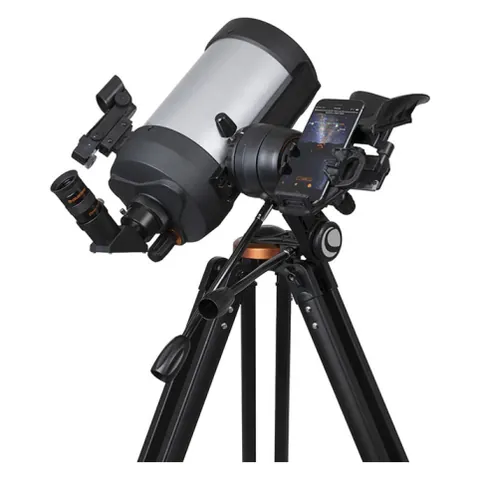 Celestron StarSense Explorer DX 5" SCT | 125 mm, 1250 mm | 295x | 231' (7.3 x the naked-eye Moon) | 92' | High Point Scientific $589.99 Celestron $649.95 |
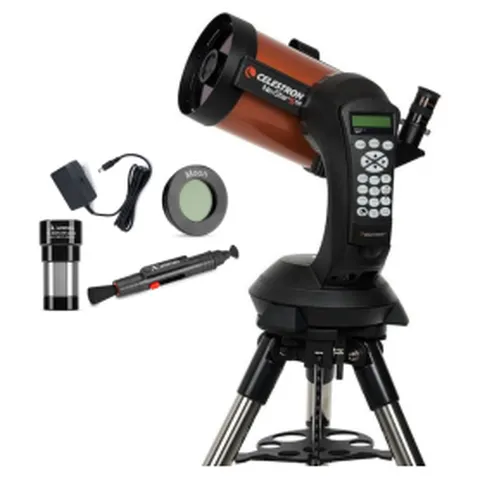 Celestron NexStar 5SE | 125 mm, 1250 mm | 295x | 231' (7.3 x the naked-eye Moon) | 92' | Celestron $899 High Point Scientific $899 |
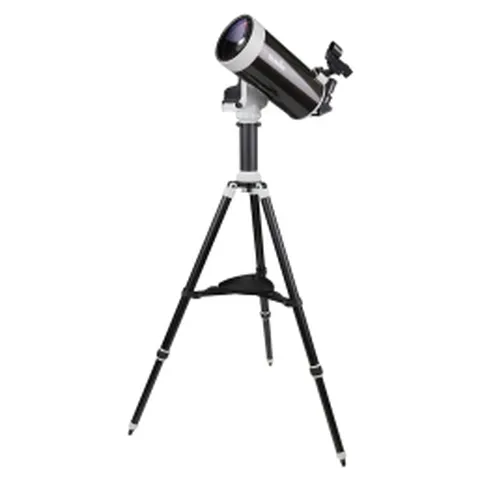 Sky-Watcher Skymax 127 AZ-GTi | 127 mm, 1540 mm | n/a | Sky-Watcher USA $995 High Point Scientific $995 | ||
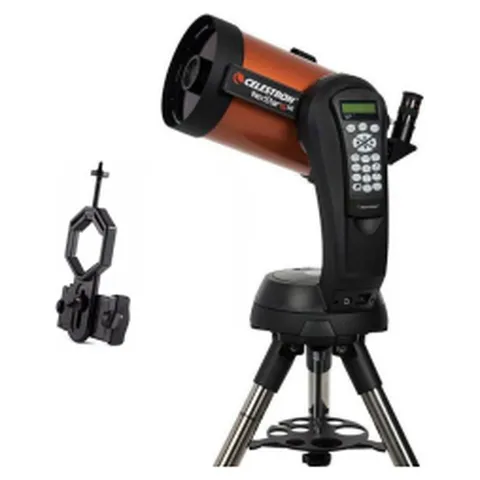 Celestron NexStar 6SE | 150 mm, 1500 mm | 354x | 277' (8.8 x the naked-eye Moon) | 111' | High Point Scientific $1,039 |
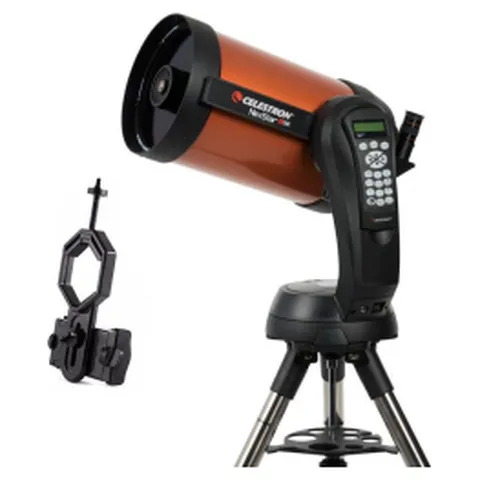 Celestron NexStar 8SE | 203.2 mm, 2032 mm | 480x | 375' (11.9 x the naked-eye Moon) | 150' | Celestron $1,499 High Point Scientific $1,499 |
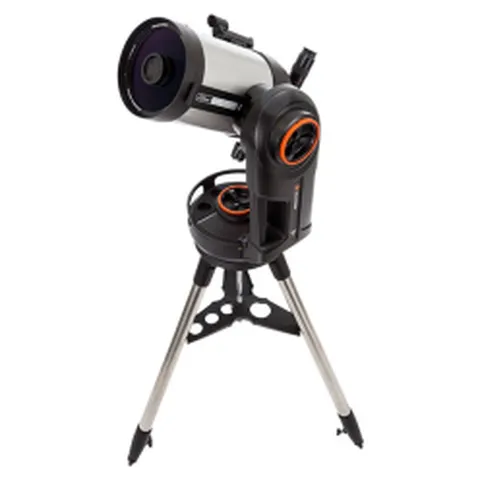 Celestron NexStar Evolution 6 | 150 mm, 1500 mm | 354x | 277' (8.8 x the naked-eye Moon) | 111' | Celestron $1,499 High Point Scientific $1,499 |
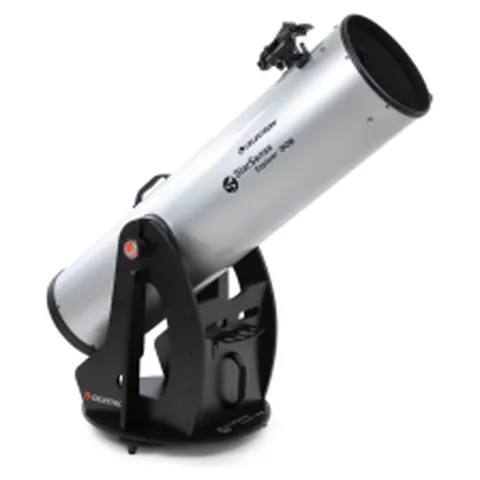 Celestron StarSense Explorer 12" Dobsonian | 305 mm, 1500 mm | 720x | 563' (17.8 x the naked-eye Moon) | 226' | Celestron $1,599 High Point Scientific $1,599 |
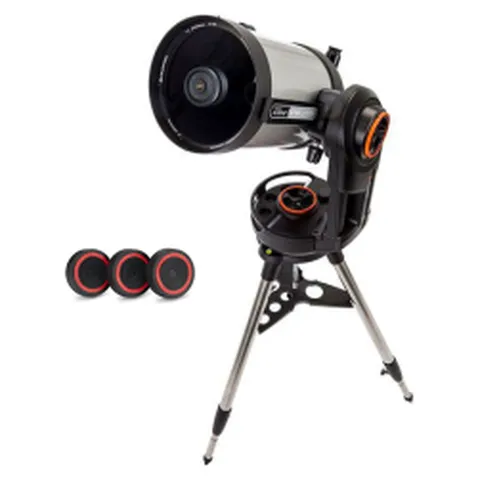 Celestron NexStar Evolution 8 | 203.2 mm, 2032 mm | 480x | 375' (11.9 x the naked-eye Moon) | 150' | Celestron $1,999 High Point Scientific $1,999 |
Why does aperture matter for planets?
Resolution is the Dawes limit, 116 divided by the aperture in millimeters (Wikipedia, Dawes' limit): 0.93" for a 125 mm telescope, 0.57" for 203 mm. Cassini's division in Saturn's rings and the bands on Jupiter are fine detail: the bigger mirror separates more of it, on nights when the air allows. The atmosphere is the limit on most nights; Celestron says it "interferes with the light from a planet or a star by defocusing it".
Can a short telescope show planets?
A 650 mm Newtonian reaches high power with a short eyepiece or a Barlow: 650 / 10 x 2 = 130x. The planet rule is about comfort at high power, not a ban. Try any combination in What will I see?; compare everything in the telescope comparison.
Celestron StarSense Explorer DX 5" SCT
Cheapest in stock meeting the planet rule
125 mm Schmidt-Cassegrain, 1250 mm focal length, tube 13 in long (published).
- Aperture
- 125 mm (4.9 in)
- Type and aiming
- alt-azimuth, app-guided push-to (StarSense)
- Weight
- 14.6 lb total
Pro compact tube for a long focal length
Con narrow field for big nebulae
$589.99price checked Nov 7
Check price at High Point ScientificFrequently asked questions
What telescope do I need to see planets?
Any telescope shows Jupiter's moons and Saturn's rings at modest power. For detail, Celestron's guideline is 'at least 5 inches (125 mm) aperture and 1250 mm focal length or more'. The table lists every telescope in our catalog that meets it.
How big will Jupiter look?
Multiply its angular size by the magnification. NASA gives 46.9 arcseconds at an average opposition: at 200x, that is about 156 arcminutes, five times the full Moon seen with the naked eye. Use our calculator for any power.
Can I see planets and galaxies with the same telescope?
Yes, but they pull in different directions. Celestron recommends long focal lengths for planets and, for faint nebulae, 'scopes of at least 8 inches (200 mm) and focal lengths of less than a 1000 mm'. A Dobsonian around 8 inches is the usual compromise.